

Research Group, Eindhoven University of Technology
Building Acoustics (BA) is the acoustics research group at Eindhoven University of Technology (TU/e). The group strives to contribute to the reduction of adverse health effects caused by human-induced noise and to promote positively perceived sound environments. The research in the group revolves around developing computational and experimental methods for acoustics in the built environment, with research areas on acoustics materials, environmental acoustics and acoustic virtual reality.
Discover Our Research
Latest News
CHORAS @ DAGA
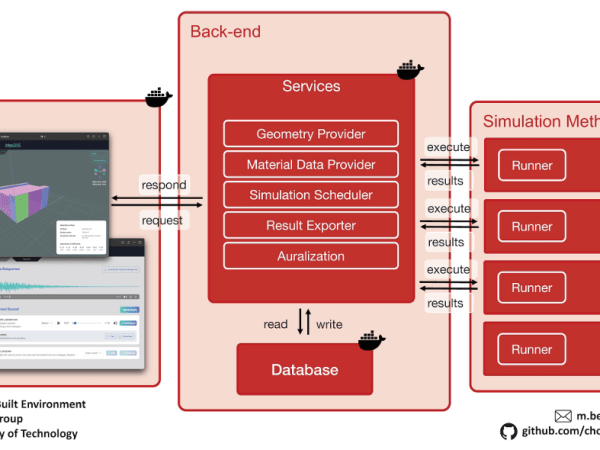
We are excited to keep spreading the word about CHORAS – the Community Hub for Open‑Source Room Acoustics Software! In the last week of March, Marco Berzborn has presented a poster at DAGA 2026 in Dresden, highlighting updates of our software pipeline and confirming the addition of a third back-end software: pyroomacoustics. If you’re curious to dive deeper,…

PhD position vacancy on urban sound modelling for Urban Air Mobility perception studies
How will future Urban Air Mobility (UAM) vehicles sound and how will UAM be perceived in our cities? If exploring that question excites you, we have an opportunity you’ll want to consider. The purpose of the project is the predict the sound of UAM vehicles in real urban settings. We target to arrive at a prediction model that provides…
JASA paper on directional coherence loss coefficients
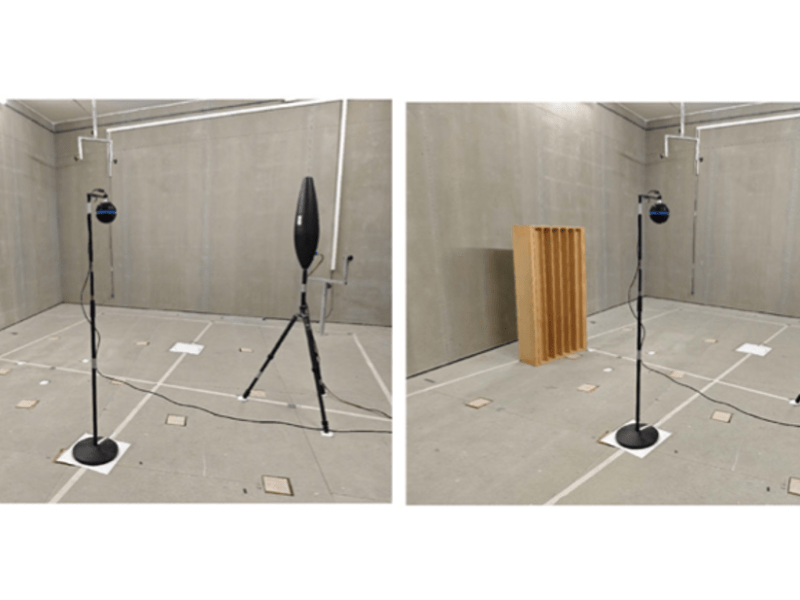
We’re excited to share our latest work:“Directional coherence loss coefficients for characterizing scattering distributions in enclosures” (JASA, Jan 2026), by Dingding Xie, Wouter Wittebol and Maarten Hornikx In this paper, we introduce Directional Coherence Loss Coefficients (DCLCs), a new way to quantify how strongly directional sound field coherence is lost due to localized scattering inside rooms, from the receiver’s…

Hary Prakoso starts to work on CHORAS
This month, we had the kick-off of the graduation project of Hary Dhimas Prakoso. He is a trainee in the TU/e programme software engineering, EngD ST. It is two years ago we started building the community hub for open-source room acoustics software CHORAS, and Hary will continue the development of this platform, in particular the…

New paper on acoustic impedance of vegetated roofs
Urban vegetation—especially vegetated roofs—has real potential for noise mitigation. But accurately measuring their acoustic properties in situ is not as straightforward as it seems. In our new paper, “Influence of transducer locations on acoustic impedance prediction in porous systems with application to vegetated roofs,” we take a close look at how small errors in source and microphone positioning can strongly affect the…
Something went wrong. Please refresh the page and/or try again.
 Building Acoustics TU/e